Upload Your Catalog to Mailchimp
When you have a catalog in Mailchimp, you get a nice possibility to:
- Add a Product content block to your e-mails to quickly promote best-selling products or special offers.
- Send personalized product recommendations to increase revenue and encourage repeat purchases.
- Segment an audience by purchase activity.
- Use individual contact purchase data to track purchases from product recommendations.
Export Product Data
You can export product data from Sana Commerce Cloud and the ERP system and import it directly to Mailchimp.
Step 1: Enable the Sync e-commerce data setting on the Mailchimp configuration page in Sana Admin.
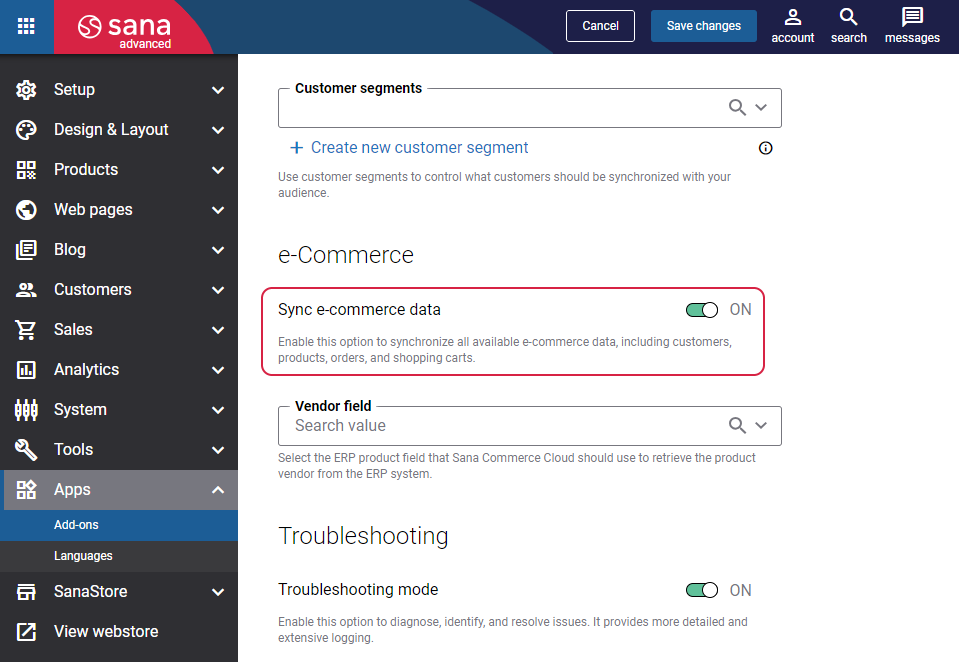
Step 2: Configure the Product data export scheduled task to run daily and keep your Mailchimp catalog up to date.
Step 3: Run the Product data export scheduled task to export your product data from Sana Commerce Cloud and ERP to Mailchimp.
When you connect Sana Commerce Cloud to Mailchimp and run the Product data export task, your product information is shared with Mailchimp so you can use it in your e-mail campaigns. This includes things like the product name, price, description, image, and stock level. With this data on hand, you can build personalized emails − product recommendations, abandoned cart reminders, back-in-stock alerts − without having to enter any product details by hand.
Every product Mailchimp receives from Sana comes with at least one variant nested inside it. If a product doesn't have variants in Sana, it's shared with Mailchimp as a single product with one variant, which simply represents the product itself. If a product does have variants − different sizes or colors, for example − each variant is nested inside that same product record, with its own price, stock level, and image. However, in Mailchimp, each variant becomes a separate product.
| Field | Description |
|---|---|
| Id | A unique product identifier. For product variants, this is a combination of the product ID and the variant ID. |
| Title | The product name. For a variant, this includes the variant name too, for example, "T-shirt, Blue, Medium". |
| Sku | A code identifying a specific variant, used as its SKU. This field only appears at the product variant level and uses the same value as Id. |
| Url | The product page URL in your webstore. |
| ImageUrl | The URL of the medium-sized product image. For a variant, this is the variant's own image if it has one; otherwise, the main product's image is used. |
| Images | A list of URLs for medium-sized product images. |
| Price | The current product price. |
| InventoryQuantity | How many units are currently in stock, rounded to the nearest whole number. |
| Description | The product description. |
| Vendor | Category name or other product field value retrieved using the Vendor field specified in the Mailchimp app configuration. See more information below. |
| Type | Same as Vendor. |
| PublishedAtForeign | The date and time the product was last updated in Sana, so Mailchimp knows how current the information is. |
Once the product data export is completed, you can find your products in Mailchimp at the following location: Content > My files. On the My Products tab, you can see your products.
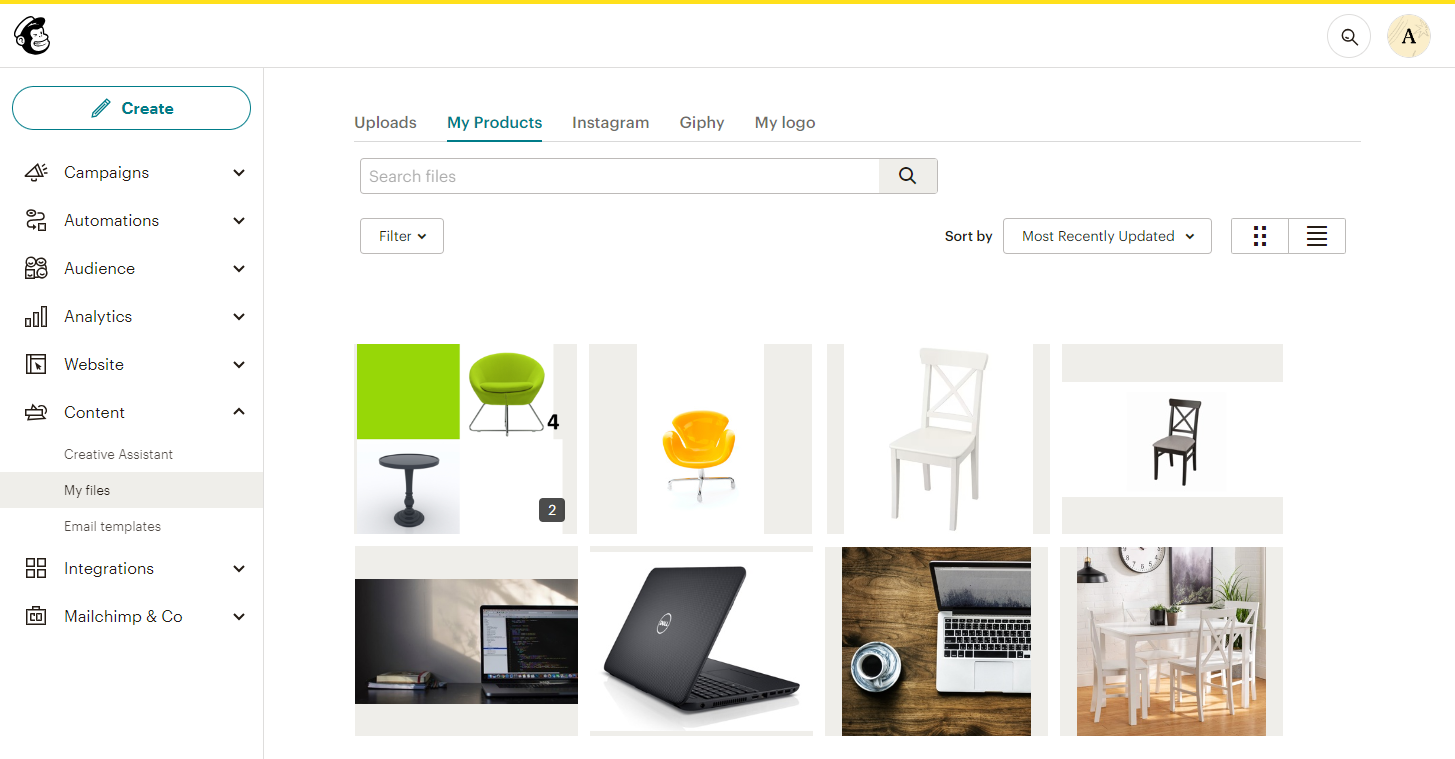
The product catalog in Mailchimp consists of products and product variants. A product variant is presented as a separate product in Mailchimp. For example, if a product has 5 product variants, in Mailchimp it will be shown as 5 separate products.
Each product includes the following information:
- Product ID
- Product variant ID (optional)
- Product title
- Product description
- URL to a product details page for the default webstore language
- URLs for medium product images
- Product price and inventory relevant for an anonymous customer
- Product vendor (optional)
Due to the technical limitation in Mailchimp, in all e-mails from you to your subscribers, all product prices are always shown in the default currency defined in your ERP system.
For example, the prices in your webstore are in 2 currencies: the euro (EUR) and the United State dollar (USD). In your ERP system only EUR is configured as the default currency of the webstore. As a result, your customers will receive prices in EUR even if they see prices in USD in your webstore.
Product Vendor
To see the product vendor in Mailchimp:
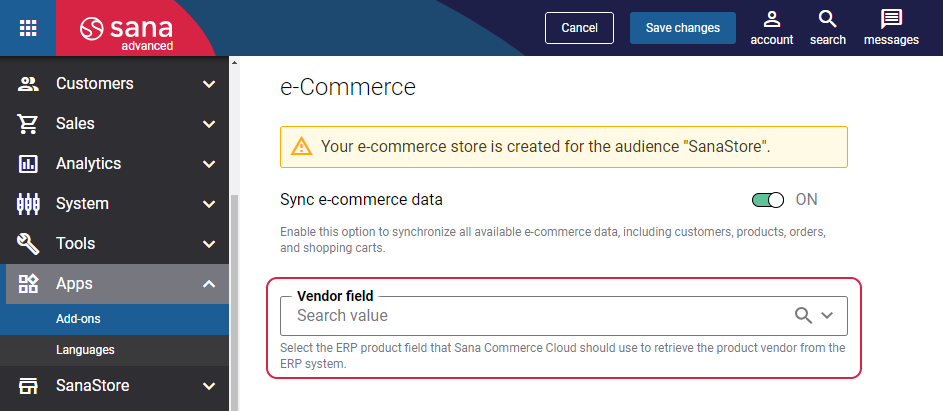
Step 1: Use the Vendor field on the Mailchimp configuration page in Sana Admin. There you can specify the field that Sana Commerce Cloud should use to retrieve the product vendor from the ERP system.
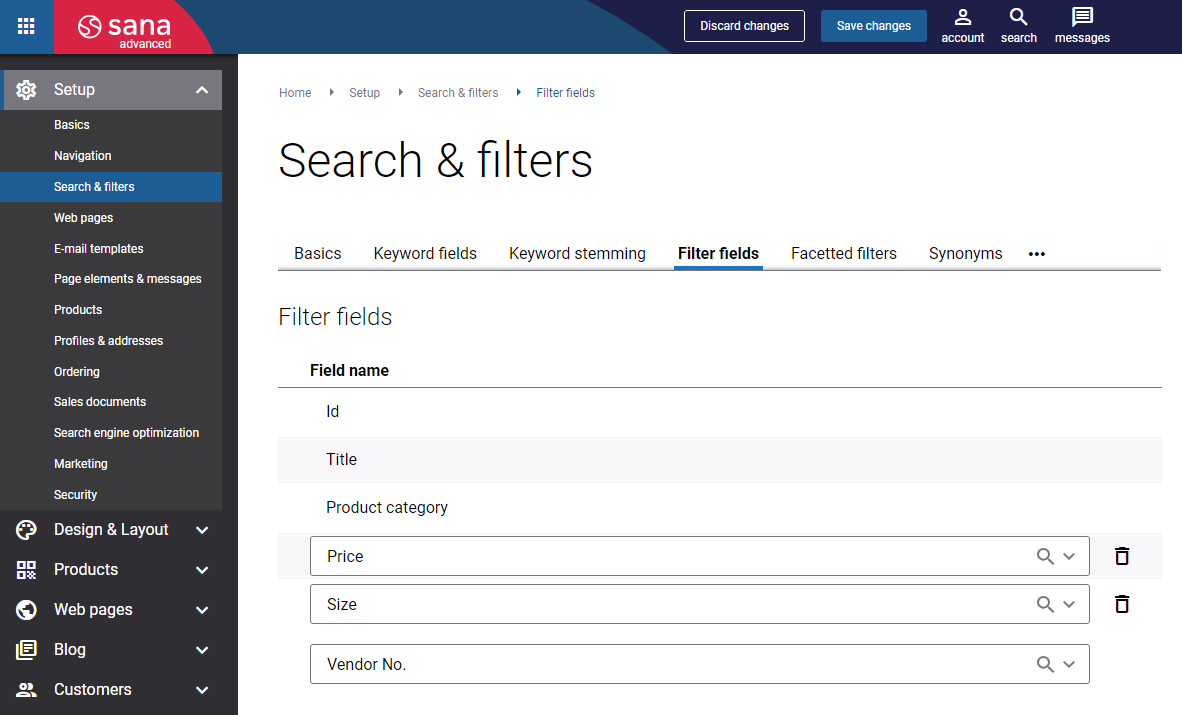
Step 2: In Sana Admin click: Setup > Search & filters > Filter fields. Add the same filter field you specified in the Vendor field.
Step 3: Run the Product data export scheduled task to export your webstore catalog to Mailchimp including vendor values for each product.


